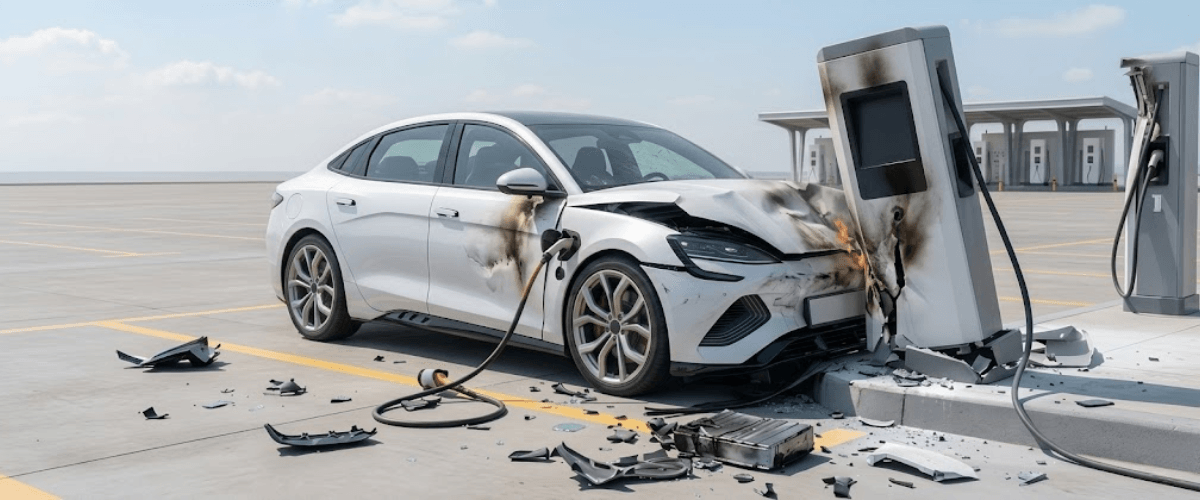
The recent Indore fire tragedy is a harsh reminder that while electric vehicles (EVs) represent the future of mobility, their safe usage—especially in residential settings—still demands serious attention. What began as a routine overnight charging session turned into a devastating disaster that claimed multiple lives, exposing critical gaps in infrastructure, awareness, and safety practices.
Initial investigations suggest that a short circuit at an EV charging point triggered an explosion, which rapidly escalated into a massive fire engulfing a residential building. The situation worsened due to secondary explosions from LPG cylinders and other flammable materials stored inside the house, turning the building into a deadly trap.
This incident is not just a one-off accident—it is a wake-up call for every EV owner, policymaker, and real estate developer in India.
Understanding What Went Wrong
The tragedy highlights a dangerous combination of factors: improper charging setup, electrical overload, poor safety planning, and lack of standardized EV infrastructure. Reports indicate that the vehicle may have been connected to a regular domestic socket, which is not designed to handle prolonged high-load charging.
Additionally, the fire spread rapidly due to electrical short circuits and explosions, showing how quickly a small fault can escalate when systems are not designed for EV-level power demand.
1. Domestic Power Load Is Not Built for EV Charging
Most Indian homes are not designed to handle the continuous high electrical load required for EV charging. Plugging an EV into a standard household socket can lead to overheating, especially during overnight charging.
This incident reinforces the importance of load assessment before installing EV charging points. Without proper circuit capacity, even a minor fluctuation can trigger catastrophic failure.
2. Charger Quality Is Not Optional—It’s Critical
One of the biggest risks in EV charging is the use of low-quality or uncertified chargers. Poor insulation, lack of thermal protection, and substandard wiring can lead to short circuits and fires.
The Indore case strongly suggests that charger quality and compatibility must be treated as a non-negotiable safety factor, not a cost-saving option.
3. Overloading Circuits Is a Silent Killer
Electrical overloading does not always show immediate signs. It builds heat gradually within wires, sockets, and connectors.
In this tragedy, a short circuit triggered an explosion at the charging point, which then ignited the vehicle and surrounding environment.
This highlights how dangerous unnoticed overload conditions can become.
4. Overnight Charging Needs Smart Monitoring
Charging EVs overnight is common, but it becomes risky when:
There is no auto cut-off system
No temperature monitoring
No smart load management
Modern EV setups should include smart chargers that automatically stop charging once full, reducing stress on circuits.
5. Poor Wiring Infrastructure Can Turn Fatal
Even a high-quality charger cannot compensate for old or poorly installed wiring. In many Indian homes, wiring is not designed for sustained high current.
Authorities are now investigating not just the EV, but also domestic wiring and electrical systems, highlighting how critical this factor is.
6. Lack of Standard EV Charging Guidelines Is a Big Gap
One of the biggest revelations from this incident is the absence of clear, enforced guidelines for residential EV charging.
Following the tragedy, the government has already initiated steps to develop standard operating procedures (SOPs) for EV charging safety.
This shows that regulation is still catching up with adoption.
7. Chain Reactions Make EV Fires More Dangerous
The EV charging blast alone did not cause all the damage—it triggered a chain reaction involving:
LPG cylinders
Electrical systems
Household appliances
Multiple explosions were reported, dramatically increasing the fire’s intensity.
This underlines how EV-related incidents can escalate far beyond the vehicle itself.
8. Emergency Systems Must Work Without Power
One of the most disturbing aspects of the tragedy was that residents were unable to escape due to system failures during the fire.
Reports indicate that power failure affected exit mechanisms, trapping occupants inside.
This highlights the need for fail-safe emergency systems that function even during power outages.
9. Awareness Among EV Users Is Still Low
Many EV users still treat charging like charging a smartphone—plug and forget.
However, EV charging involves:
High voltage
Long duration
Heat generation
Even local EV users have now emphasized the need to strictly follow manufacturer guidelines and disciplined charging practices.
10. EV Growth Without Infrastructure Is Risky
India’s EV adoption is growing rapidly, but infrastructure and awareness are not keeping pace.
The Indore tragedy clearly shows that:
Technology adoption without safety planning is dangerous
Residential charging needs professional setup
Regulations must evolve faster
The Bigger Lesson: EV Safety Is a System, Not a Feature
This tragedy is not about EVs being unsafe—it is about systems failing around EV usage.
Safe EV adoption depends on:
Proper electrical infrastructure
Certified charging equipment
Load management systems
Clear safety protocols
Without these, even the most advanced EV becomes a risk.
Final Thoughts
The Indore incident has changed the conversation around EV safety in India. It is no longer just about range, battery life, or cost—it is about safe integration into everyday life.
As EV adoption accelerates, the focus must shift from convenience to compliance and safety-first infrastructure. Because in the end, the real cost of ignoring these lessons is far greater than any savings on installation or equipment.

Rohit Sharma
AuthorLast updated 17 hours ago