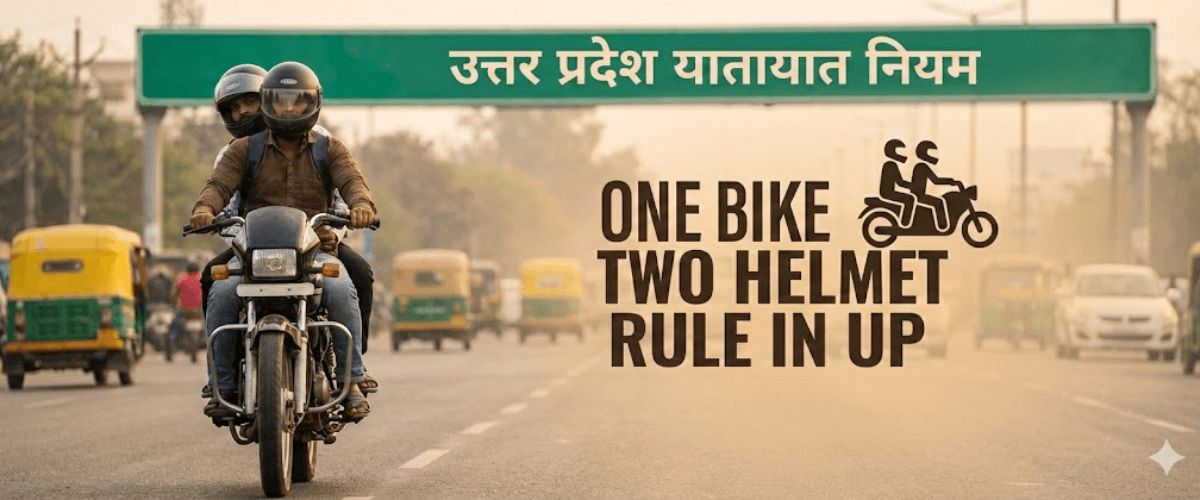
To reduce the increasing number of road accidents and fatalities, the Uttar Pradesh Transport Department has introduced a strict new safety regulation known as the One Bike Two Helmet Rule. This rule aims to protect not only the rider but also the pillion passenger, who is often the most vulnerable in two-wheeler accidents.
According to government data, a large percentage of deaths in road accidents occur due to non-usage of helmets, especially by people sitting at the back. Keeping this in mind, the UP government has made major changes to two-wheeler safety and registration rules.
What Is the One Bike Two Helmet Rule in Uttar Pradesh?
Under the One Bike Two Helmet Rule, every two-wheeler rider in Uttar Pradesh must ensure that:
The rider wears a helmet
The pillion passenger also wears a helmet
If a rider is found traveling with a pillion passenger who is not wearing a helmet, strict action will be taken, including a fine and suspension of the driving license.
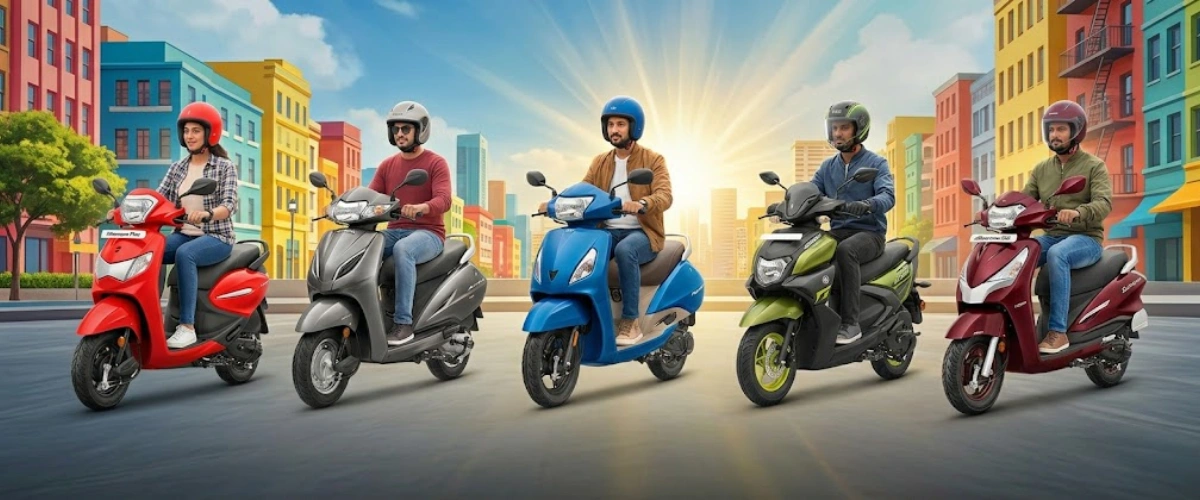
This rule applies to both bikes and scooters and is being enforced across urban and rural areas of Uttar Pradesh.
Mandatory Two Helmets While Buying a New Bike or Scooter
The Transport Department has also tightened rules for new two-wheeler purchases. From now on:
No dealer can sell a bike or scooter without providing two ISI-certified helmets
One helmet is mandatory for the rider
The second helmet is mandatory for the pillion passenger
If the buyer refuses to purchase two helmets, the vehicle will not be sold or registered.
This step ensures that riders have no excuse for allowing a pillion passenger to travel without proper safety gear.
Only ISI and BIS-Certified Helmets Are Allowed
Not all helmets are considered legal under this rule. The government has clearly stated that:
Both helmets must be BIS-certified
Helmets must carry a valid ISI mark
Cheap roadside or non-certified helmets are not acceptable
Authorities have emphasized that low-quality helmets can increase the risk of fatal injuries instead of preventing them. Therefore, quality standards are being strictly enforced.
Helmet Details Mandatory Before RC Issuance
To ensure full compliance, the Transport Department has made it compulsory to upload helmet details before vehicle registration:
Dealers must record helmet details such as:
Helmet model number
Helmet code
Certification details
These details must be uploaded on the official vehicle portal
The helmet information must also be clearly mentioned on the purchase invoice
If the helmet data is not uploaded, the Registration Certificate (RC) will not be issued.
Strict Action Against Dealers for Rule Violation
The new regulation also holds vehicle dealers accountable. If a dealer is found:
Selling a two-wheeler without providing two certified helmets
Uploading incorrect or false helmet details
Failing to follow registration guidelines
Then the Transport Department can take strict action, including cancellation of the dealer’s trade certificate.
This ensures responsibility at every level, not just for riders.
Penalty for Riding Without Helmet in UP
After the rule implementation, enforcement drives have been intensified across the state. Traffic police, transport officials, and local police are conducting joint checking campaigns.
Under Section 129 and Section 194D of the Motor Vehicles Act:
₹1,000 fine for riding without helmet
Driving license suspended for 3 months
Repeated violations may lead to permanent cancellation of license
This penalty applies if either the rider or the pillion passenger is found without a helmet.
Why the UP Government Introduced This Rule
The Uttar Pradesh government introduced the One Bike Two Helmet Rule with a clear focus on saving lives and improving overall road safety. A large number of fatal road accidents are linked to serious head injuries, especially among pillion riders who often ignore helmet usage. By making helmets compulsory for both the rider and the person sitting behind, the government aims to ensure equal protection for everyone on a two-wheeler. This rule also promotes responsible riding behavior and encourages people to view helmets not as a legal burden, but as a daily safety habit. Road safety experts strongly believe that compulsory helmet usage for both riders can significantly reduce the risk of fatal injuries during accidents and help bring down the overall accident death rate in the state.
Public Awareness and Enforcement Campaigns
In addition to imposing fines and penalties, the UP government is actively running public awareness and enforcement campaigns to educate citizens about the importance of road safety. These campaigns focus on explaining why ISI-certified helmets are essential, highlighting the dangers of riding without proper head protection, and making people aware of the legal consequences of violating helmet rules. Through combined efforts of traffic police, transport authorities, and public messaging, the government believes that awareness supported by strict enforcement will lead to long-term behavioral change and make safer riding practices a norm across Uttar Pradesh.
Conclusion
The One Bike Two Helmet Rule in UP is a strong and necessary step toward improving road safety. While the rule may feel strict initially, it has been introduced to save lives, especially those of pillion passengers who are often ignored in safety norms.
If you ride a two-wheeler in Uttar Pradesh, make sure you always follow this rule:
One Bike + Two Helmets = Safer Roads
Following this rule not only helps you avoid fines but also ensures the safety of you and your loved ones.
FAQs – One Bike Two Helmet Rule in UP
1. What is the One Bike Two Helmet Rule in UP?
It is a rule that makes helmets mandatory for both the rider and the pillion passenger on a two-wheeler.
2. Is helmet compulsory for the pillion rider in Uttar Pradesh?
Yes, wearing a helmet is compulsory for both rider and pillion passenger.
3. What is the fine for not wearing a helmet in UP?
The fine is ₹1,000 along with suspension of the driving license for three months.
4. Can my driving license be suspended for helmet rule violation?
Yes, the driving license can be suspended for three months for violating helmet rules.
5. Is the rule applicable to both bikes and scooters?
Yes, the rule applies to all two-wheelers including bikes and scooters.

Rohit Sharma
AuthorLast updated 15 hours ago